
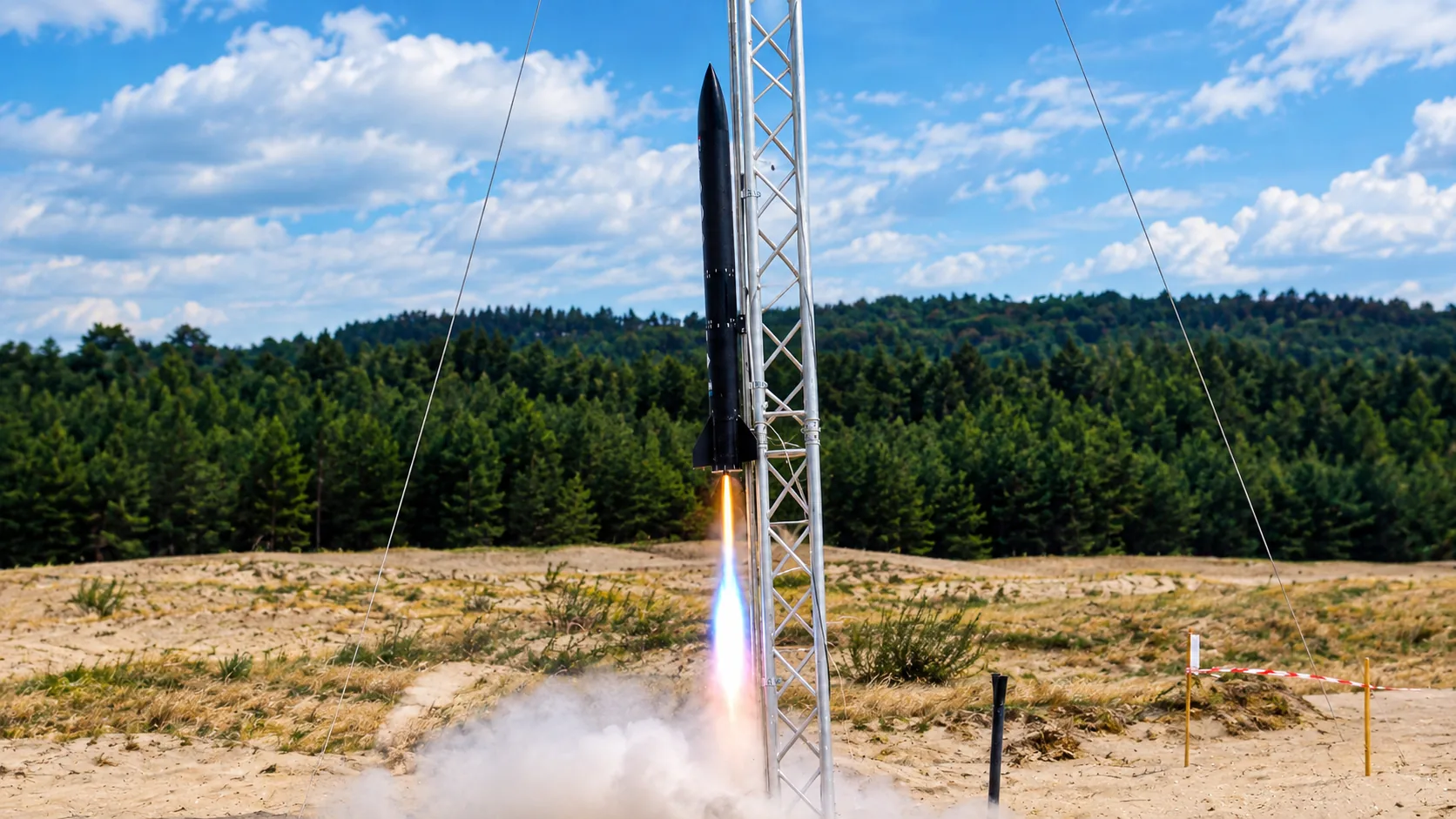
The evolution of our rockets, generation after generation
3
Rocket programmes
100%
In-house development
3600+
Engineering hours per year
10+
Successful launches
SIERRA
The team's first in-house rocket family
Length
1.5 m - 2 m
Mass
5 kg
Propulsion
COTS solid-propellant motor
The SIERRA programme was the team's first rocket family designed and developed entirely in-house. In 2024, four experimental launches took place within the programme, whose primary goal was to test our own onboard electronics, the structural strength of the rocket body, and the parachute recovery system under real conditions. The experience and measurement data gained during the test flights laid the foundation for the further development of later designs, which directly contributed to the success of subsequent missions and the rapid reusability of the rockets.
Flights
SIERRA IMarch 2024
First launch, the rocket was lost after lift-off due to a motor failure.
SIERRA IIMay 2024
SVINDIK, rocket competition in Slovakia. 1st place in the Big Rocket Cup. The first fully successful mission in the team's history. Apogee: 270 m
SIERRA IIISeptember 2024
Festiwal Meteora, Poland. Live telemetry, GPS coordinates, improved in-house avionics. Apogee: 570 m
SIERRA IVOctober 2024
The rocket flew again at the Baja rocket weekend. After the upgrades the apogee was 750 m.
ARGOS
The team's test rocket programme
Length
1.5 m
Mass
8 kg
Propulsion
COTS solid-propellant motor (Cesaroni 38mm and Aerotech 54mm)
The ARGOS programme was the team's test rocket programme, where subsystems for the Odyssey hybrid rocket were tested and validated under real conditions, so that a reliable, flight-proven system could be installed in the large rockets, with the system's early teething problems already eliminated. The rockets were 3D printed from ABS plastic and built from modular segments to aid printability. The system was developed with continuous radio-communication telemetry, GPS/GNSS coordinates, internal rocket states and apogee downlink. A COTS parachute deployment system was used, where the overpressure gas released from a CO2 cartridge pushed off the nose cone, pulling out the parachute with it.
Flights
ARGOS IMarch 2026
The first launch of the rocket programme, a fully successful launch. Apogee: 475 m, Caseroni 38mm solid motor.
ARGOS IIMay 2026
SVINDIK, rocket competition in Slovakia. The rocket was lost immediately after leaving the launch pad due to an error during motor assembly. Aerotech 54mm solid motor.
ARGOS IIIJune 2026
Baja rocket weekend. The rocket survived lift-off and the high-speed ascent phase, but could not withstand the high heat and vibration from the burnt-out motor at the apex of the flight path, so it broke in two and landed in several pieces, unfortunately no useful data could be recovered from the memories. Aerotech 54mm solid motor.
ODYSSEY
The team's hybrid rocket family
The Odyssey Alpha rockets were built with a 125 mm inner diameter, fully in-house manufactured carbon-fibre body and fins. The avionics mounting bulkhead components were CNC-machined from aluminium, and the complete electronics system was housed inside. Side panels suitable for external mounting were placed on the outside of the AV bay, housing the antennas, cameras and the magnetic electrical connector through which the GSE ground system can charge the batteries and communicate live with the rocket on the launch pad. The rockets launched on Aerotech 54 mm, 1280 Ns total impulse solid motors, reaching an apogee of almost 1 km. During flight, telemetry data is displayed at the ground control station via continuous radio communication. A novelty is that a 5.8 GHz live FPV drone camera was mounted on one of the AV bay side panels, continuously transmitting the camera image during flight even at high ascent rates.
Flights
Alpha ISeptember 2026
Apogee: 869 m.
Alpha IIOctober 2026
Apogee: 895 m.
Alpha IIIQ4 2026
Chute test version.
Beta IQ1 2027
The first flight of the rocket equipped with a hybrid motor in the team's history…
IREC 2027 flightQ2 2027
IREC 2027 competition rocket, Texas, USA. Development in progress. 3 km apogee, aiming for the most precise altitude possible…
Join a student community where engineering knowledge turns into real experience through real projects.
Join us